- Productivity Stacks Newsletter
- Posts
- #278: 3 Easy Ways To Turn Anxiety Into Sustained Focus, By A Psychologist
#278: 3 Easy Ways To Turn Anxiety Into Sustained Focus, By A Psychologist
Why Smart Leaders Do Less

Jenae Spry
April 17, 2026
In partnership with

Productivity Stacks Newsletter
Issue No. 278
The Best in Evidence-Based Productivity
for Small Business Owners, Freelancers & Founders
Helping You Work Smarter and Live More
The Rundown
3 Easy Ways To Turn Anxiety Into Sustained Focus, By A Psychologist
I quit my VP job at 36 to become a solopreneur. I don't need staff: AI agents handle everything from invoices to proposals.
Why Smart Leaders Do Less
The people who made NotebookLM just dropped a new app, and I'm obsessed
Anthropic's office is surprisingly AI-first, even for an AI company
👉Did you miss an issue? Check out previous Productivity Stacks issues anytime here
Sponsor
Jenae’s note: I have not used Viktor but I did research it and the only reason I’m not working with it, is that it primarily works in Slack as a starting point. And while I have slack, I don’t use it much. It really shines if you do though!
Stop babysitting dashboards. Ship from Slack. Touch grass.
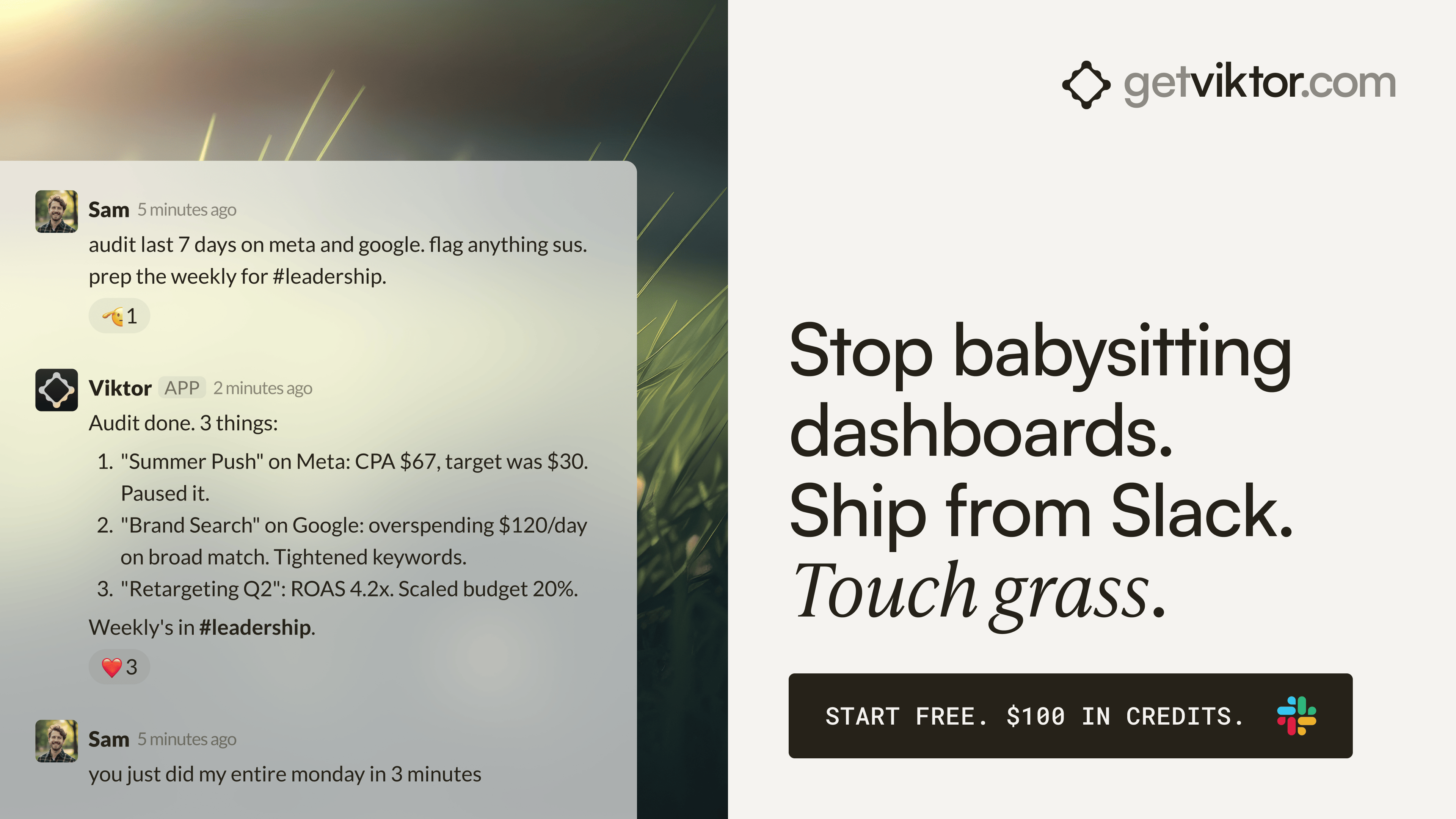
700+ teams have Viktor reading their Google Ads every morning.
Your media team opens Slack at 8am. There's a cross-platform brief in #growth: Google Ads spend vs. ROAS, Meta CPA by campaign, Stripe revenue by channel. Viktor posted it at 6am. Nobody asked for it.
Last week, one team's Viktor caught a spend spike at 2am on a broad match campaign and flagged it in Slack: "CPA up 340%. Recommend pausing and shifting budget to the top two performers." That would have burned $3K by morning. The media buyer woke up to a problem already handled.
Your strategist reviews spend trends. Your account manager checks revenue attribution. Same Slack channel, same colleague, before anyone's first coffee.
Google Ads, Meta, Stripe. One message. No Looker, no Data Studio. Anomaly detection runs around the clock. Cross-platform reporting runs on autopilot.
5,700+ teams. SOC 2 certified. Your data never trains models.
"Viktor is now an integral team member, and after weeks of use we still feel we haven't uncovered the full potential." — Patrick O'Doherty, Director, Yarra Web
🔥Quote/Prompt
By being yourself, you put something wonderful in the world that was not there before.
Use the quote as a writing or thinking prompt to finish your week strong.
A bit from mine:
(posted in our Doer Entrepreneurs Free Community — off social media)
Productivity advice is EVERYWHERE. And a lot of it is genuinely good. But good advice for someone else isn't automatically good advice for you.
I think about this a lot when I'm working with clients on building their […]
Did someone forward this to you?
📈 Performance
We've all been there the night before something big. Presentation, client call, proposal due. You've prepared. You know your stuff. And yet your brain is absolutely refusing to let it go. You run through every possible way it could go sideways instead of just sleeping.
Here's the thing: most of us respond to that feeling by trying to calm down. Slow the breathing, quiet the thoughts, get it together. And according to research, that's actually working against you. Anxiety is a high-arousal state. Calm is a low-arousal state. Trying to jump between them under pressure is a lot to ask of your nervous system. This piece from Forbes walks through three strategies that work WITH the arousal instead of fighting it.
"Anxiety frames the situation as a threat. Excitement frames it as an opportunity. Both produce elevated heart rate, sharpened attention and a body primed for action. The difference is interpretive...the next time you feel anxious before something that matters, don't tell yourself to calm down. Tell yourself that you're excited instead. Say it out loud, if you can. It takes two seconds and works not by suppressing your nervous system, but by redirecting the arousal it's already producing toward engagement rather than avoidance."
Key Insights:
Telling yourself "I am excited" out loud before a high-stakes moment may shift you from a threat mindset to an opportunity mindset. Research from Harvard Business School found this simple reappraisal outperformed calming strategies across tasks like public speaking and math performance. Worth knowing this finding is still early and warrants more replication before treating it as settled.
Naming what you're anxious about SPECIFICALLY (like "I'm worried I'll forget my opening line" rather than just "I'm nervous") has the strongest scientific backing of the three. Multiple independent studies show that labeling negative emotions measurably reduces activity in the brain's threat-detection center and shifts more control to the part of the brain responsible for focused, goal-directed thinking.
Elite performers aren't less anxious before high-pressure moments. They've learned to read the arousal as a signal that they're engaged and prepared, not that something is wrong. Stress reappraisal research generally supports this, though the specific study the article cites was smaller than it sounds (28 participants at follow-up) and tested the GRE, not a math exam as described.*
The article is worth reading for the full breakdown of all three strategies and the practical reset question in the final section.
Note for the deep divers: The Yerkes-Dodson Law (framed here as a "landmark principle replicated extensively" in humans) is actually more of a useful heuristic. The original study was done on mice in 1908, and modern reviews find the inverted-U pattern holds up inconsistently for complex cognitive tasks. The intuition behind it isn't wrong…it just doesn't have the clean track record the article implies. So still worthwhile.
*The article describes the control group in the 2010 Jamieson stress reappraisal study as being told to "ignore stress." The actual control received no instructions. That detail comes from a later 2016 follow-up study.
⚙️ Optimization
Running a business solo used to mean doing everything yourself or paying someone else to do it. The math never quite worked — hire help and watch your margins shrink, or stay lean and drown in admin. Justin Parnell found a third option, and his setup is worth a look if you've ever wished you could clone yourself for the boring stuff.
In my own business, agents handle everything from inbound inquiries to proposal building. For example, when someone fills out a form on my website, they receive a custom road map for building agents. Another agent generates a proposal and sends it along with a meeting link to book time on my calendar... These agents save me hours on every project. There's an AI workflow running in the background that I barely touch, which makes me massively more efficient.
Key Insights:
AI agents can cover the full client intake cycle without you touching it — from the moment someone fills out a form on your site, through proposal generation, contract signing, and invoicing, the whole sequence can run on autopilot, which is exactly what Parnell built for his own business.
The real margin protection isn't revenue — it's headcount. Parnell estimates he'd need at least two additional hires or contractors to handle what his agents do now, and avoiding that cost is what keeps a solo operation actually profitable.
You don't need a technical background to get started. Parnell taught himself using YouTube, ChatGPT, and free Google certifications before building anything — the barrier to entry is lower than it looks.
Read the full article for a breakdown of how Parnell's intake-to-invoice workflow actually runs and how he structures agents for client lead qualification.
⏲️ Time Management
Let's be real, most productivity advice is about doing MORE. More systems, more hustle, more optimization. So when the advice is literally "do less," it tends to stop people in their tracks.
This piece from Psychology Today argues that the quality of your decisions degrades the more of them you make in a day, and that the smartest leaders protect their mental energy by cutting decision load wherever possible.
"Doing less isn't about avoiding responsibility. It's about protecting the mental space to make choices that drive results."
Key Insights:
Front-loading your most important decisions for your peak energy time works well for morning people, but if you're an evening chronotype (roughly 25-30% of the population), your cognitive peak is later and morning is ACTUALLY your worst window, so knowing your own patterns matters more than following the generic advice.
Building routines and defaults to eliminate repeat choices, like a standard work wardrobe, automated email filters, or a weekly meal plan, frees up mental energy for higher-stakes decisions without requiring any extra effort once the system is in place.
Delegating decisions that don't require your direct input isn't just about efficiency. It's about preserving the quality of judgment you bring to the ones that do, and that distinction is what separates leaders who stay sharp from ones who slowly grind down.
Read the full article for the complete breakdown of all five strategies and the specific systems Jake Brydon (founder of Heritage Construction) uses across his businesses.
Note for the deep divers: The science framing is shakier than it sounds. The article presents decision fatigue as settled neuroscience, but the core research behind it (Baumeister's ego depletion model) has had a rough decade. A 23-lab replication attempt found effects close to zero, and a 2025 review of 82 relevant studies found only 45% showed support. The article also leans on a Nature study to claim mental fatigue reduces empathy…except that study was actually about COVID policy attitudes during the pandemic in Australia. Not quite the same thing.
The practical takeaways are still worth your time. Just go in knowing the "proven neuroscience" framing overpromises a bit.*
*The article cites a "recent study" on decision-making as an original experiment. It's actually a literature review that hadn't completed final peer review at time of publication.
💻 Tools & Technology
If NotebookLM's Audio Overview is already part of how you learn, this one's going to feel very familiar. Huxe is a new app built by the same team, and it does one specific thing really well: turns your daily information into an interactive AI-generated podcast. Not a summary you skim. An audio briefing you can actually talk back to.
Setup takes about five minutes. You connect your email, calendar, and whatever topics you follow (news, markets, tech, specific subreddits, RSS feeds, X posts). From there it pulls everything together into a fresh daily briefing with no repeats from the day before. The whole thing runs in the background once it's configured.
"What I appreciate most about Huxe is the minimal effort required to receive daily updates on topics that interest me. Once everything is set up, it aggregates content from the linked sources and presents it in an audio format without repeating previous material. Thus, if you set things up thoughtfully, you can simply enjoy the results without any additional effort."
Key Insights:
Huxe connects to your email, calendar, and interest topics like subreddits, RSS feeds, and X posts to generate a personalized daily audio briefing, so your morning catch-up is built around what you actually care about.
All content is interactive, meaning you can jump into any briefing mid-listen to ask questions, similar to how NotebookLM's Interactive mode works, without leaving the app or opening a new tab.
The app is free, rated 4.8, and only a few months old, so a few rough edges exist like bugs with subreddit browsing and no Android Auto support yet, but the core experience is already strong.
Read the full article for a complete walkthrough of the Discover tab, how to add custom sources and prompts, and how it compares to NotebookLM's Audio Overview feature.
🤖 AI
Running your own business means figuring out tools as you go, but most of us are still treating AI like a fancy search engine we occasionally ask to draft something. Anthropic is a few steps ahead of that, and what they've built internally is worth paying attention to.
The company says employees now rely on Claude for roughly 60% of their day-to-day work and report around 50% productivity gains. The interesting part isn't the number though. It's HOW they got there. Instead of each person figuring out their own prompting approach, Anthropic built a system called "Skills": packaged, version-controlled workflows that capture what actually works and make them reusable across the company. When someone in finance finds an effective way to use Claude for contract review, that workflow becomes a Skill, and the next person who needs it gets the same quality on day one.
"When someone in finance figures out an effective way to use Claude for contract review, that workflow becomes a 'Skill', and the next person who needs it gets the same quality on day one instead of building their own version from scratch. The work is consistent, auditable, and reproducible."
Key Insights:
The "Skills" system is the most transferable idea here for small teams. Instead of every person reinventing their AI workflow, you document what works and share it, which is something any solopreneur or small team can do right now with a shared prompt library or Google Doc.
Anthropic's internal data shows that about 27% of AI-assisted work would not have been attempted at all without Claude, meaning AI isn't just speeding up existing tasks. It's expanding what people actually take on, which changes how you should think about capacity.
The productivity gains are real but come with a catch the article is honest about: employees also spend extra time understanding and checking AI outputs, especially in unfamiliar areas, so overall workload often increases even as individual tasks get faster.
Read the full article for the legal team's contract review plugin built in a single afternoon, the Wiz codebase migration story, and what industry experts think about the "Claude as operating system" framing.
Note for the deep divers: The 200% engineering productivity figure comes from measuring pull requests per engineer. Boris Cherny himself called it "the simplest, stupidest measure," and it's widely criticized for being easy to inflate when AI tools split work into smaller chunks. Anthropic's own internal research page reports a 67% increase in merged PRs, which tells a different story. The productivity numbers overall are also self-reported by Anthropic employees, so read them as directionally interesting, not independently verified.*
*The article describes Mike Krieger as Anthropic's chief product officer, but he transitioned out of that role in January 2026 to lead an internal incubator team. Ami Vora is now head of product.
🎉 Celebration Corner
Every week Doers Inner Circle members do a weekly review & get help when they need it — check out the progress they made this week!
FINALLY completed application to be certified in [country]. hurrah! should help with bringing in consistent income!
All billable done, and projects booked!
What did you do this week? We feature non-member successes too. Just post them here!
🔒Inner Circle: Events & Announcements
We will soon be adding Referral Perks — Refer now to start earning! 👇
As a reminder, you’re getting this twice-weekly newsletter because you opted in to receive awesome productivity and systems tips through one of these methods:
Doer Entrepreneurs, Doers Express Newsletter, Productivity Stacks, Success by Rx, ClickUp Facebook Group, Productive & Successful Translators Facebook Group.
If you’re not interested in improving your and your business’s productivity so you’d like to break up, that’s definitely a bummer. But, you can always use the unsubscribe link at the bottom if you do not want to get these tips — but keep in mind I am hyper-focused on making these twice-weekly emails as valuable as possible.
Got a tip? Hit reply!
I hope you found this valuable!
Wishing you much productivity!
- Jenae :)
Interested in reaching thousands of motivated small business owners, freelancers & founders?
Hit reply and let’s chat about sponsorship. We only include ads that match our mission: to help our readers work smarter and live more.