- Productivity Stacks Newsletter
- Posts
- #266: Can 'friction-maxxing' fix your focus?
#266: Can 'friction-maxxing' fix your focus?
What if the real risk of AI isn't deepfakes — but daily whispers?

Jenae Spry
March 06, 2026
Productivity Stacks Newsletter
Issue No. 266
The Best in Evidence-Based Productivity
for Small Business Owners, Freelancers & Founders
Helping You Work Smarter and Live More
The Rundown
Can 'friction-maxxing' fix your focus?
How "Deep Industry Research Agents" Can Change Your Organization
I replaced my read-it-later app with NotebookLM and stopped forgetting what I read
I used Gemini to automate Google Keep and Google Tasks, and it's been a game-changer
What if the real risk of AI isn't deepfakes — but daily whispers?
👉Did you miss an issue? Check out previous Productivity Stacks issues anytime here
Sponsor
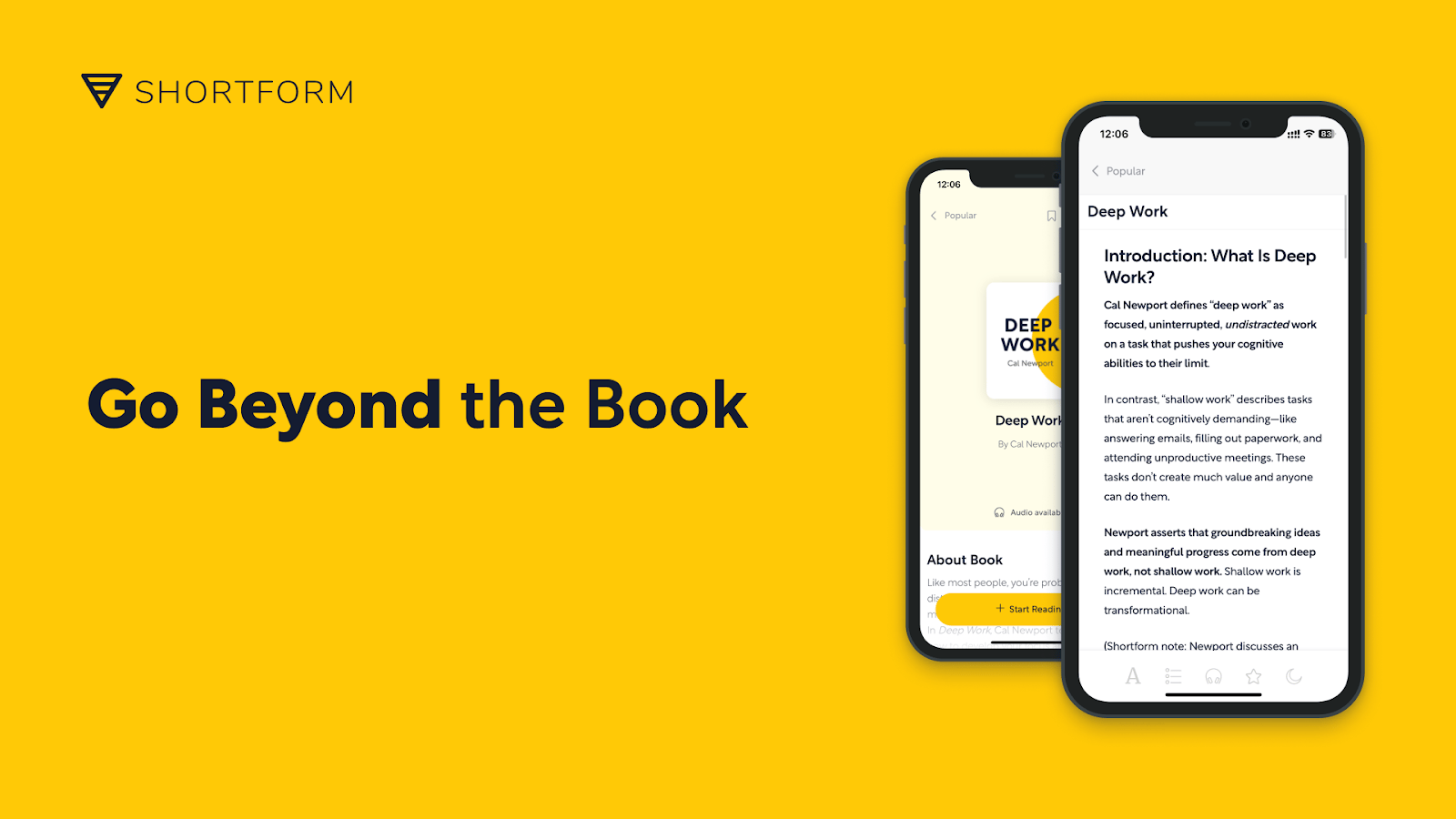
The Shortform feature nobody talks about (but should)
Everyone focuses on the book guides. And yeah, they're great.
But can we talk about how Shortform actually tells you when a book is WRONG?
Here's what I mean:
I was looking at a new and popular book for our book club. Pulled up Shortform first to get some more information about the book.
Their analysis section flagged that several of the book's claims have been contradicted by research.
The book sounded authoritative. It had great reviews. But some of its core advice was based on questionable science.
This is what sets Shortform apart:
They don't just summarize. They fact-check. They bring in other sources. They tell you when experts disagree with the author's conclusions.
It's like having a research team vetting everything you read.
The result? I'm not just reading faster. I'm reading smarter. I know which ideas are solid and which ones to take with a grain of salt.
Because consuming information isn't the same as consuming GOOD information.
Right now just for you guys: $50 OFF the annual plan by using https://shortform.com/express
🔥Quote/Prompt
Take time first thing to visualize an incredible day.
Use the quote as a writing or thinking prompt to finish your week strong.
A bit from mine:
(posted in our Doer Entrepreneurs Free Community — off social media)
Here's the thing about visualization — it's not about imagining a perfect day and hoping it shows up. It's about giving your brain a clear target before the chaos of the day tries to set one for you.
And if you're a freelancer or small business owner, you […]
Did someone forward this to you?
📈 Performance
Attention spans are shrinking, and if you're running a business in 2025, you're probably feeling it. You're in the middle of a task that should take 20 minutes but somehow you're 4 tabs deep into something completely unrelated. This BBC piece digs into the growing "friction-maxxing" trend: the idea that strategically adding inconvenience back into your day can retrain your brain for deeper focus. It's an interesting concept, but the experts aren't fully sold either, so before you throw your phone in a lake, it's worth understanding what the research actually says.
"Strategically adding friction back into our lives by reducing our reliance on technology can retrain our brains for better focus, cultivate resilience and create a positive sense of autonomy. 'We have been letting technology take control of our behaviour,' says Larry Rosen, a research psychologist and professor at California State University. 'We have to take back control of ourselves.'"
Key Insights:
Our average attention span on a screen has dropped from about two and a half minutes in 2004 to just 47 seconds in 2016, but not all experts agree technology is solely to blame. The research is more nuanced than the headlines suggest.
Effort does appear to be neurologically rewarding. Brain scan studies show reward centers are more active when a payoff requires real work, but that doesn't automatically mean inconvenience alone fixes focus.
Friction-maxxing may be most useful not as a wholesale lifestyle overhaul, but as a way to be more intentional about where you let technology make decisions for you, such as swapping GPS for actually knowing where you're going or writing notes by hand before typing them up.
Read the full article for the full breakdown of what the research supports, where experts push back, and how to think about adding friction in a way that's actually practical rather than performative.
⚙️ Optimization
Most productivity gains from AI get talked about in vague, hand-wavy terms. This Harvard Business Review piece is different. It looks at a real deployment of what the authors call "deep industry research agents" at PIMCO, a $2.26 trillion asset manager, and the results are specific enough to actually mean something for how you think about AI in your own operations. And even if you're a solo freelancer with no team in sight, stick with me here because there's a practical takeaway buried in this one that I think translates surprisingly well.
"A very large share of the exceptions were not true errors. Instead, they were explainable differences caused by known and legitimate variations in methodology. Once the DIRAs learned these patterns, they were able to automatically recognize these known differences, reconcile them without requiring manual investigation, and flag only true anomalies for human review, a shift that, by eliminating low-value investigative work, could potentially free 65–70% of the team's time."
Key Insights:
The biggest productivity wins from AI are not about replacing people but about identifying the low-value work that quietly consumes most of your day. For freelancers, you can get a surprisingly similar outcome just by asking a basic AI chatbot to help you map out every task and context switch in your week. What comes back often reveals patterns you had completely stopped noticing.
Narrow beats broad when deploying AI tools. Agents that are tightly configured around a specific, well-defined task learn faster and perform better than trying to automate everything at once, which applies whether you are managing a full operations team or just yourself.
AI tools become more valuable the sooner you start using them consistently, because the insights compound over time as patterns emerge from real work rather than guesswork.
Read the full article for the six-step framework for deploying AI agents in your operations, including how to phase in automation without introducing new risk.
⏲️ Time Management
Saving articles to read later sounds like a great system until you realize your read-it-later app has become a graveyard of good intentions. And even when you do get around to reading something, retaining it is a whole other problem. This piece walks through one writer's practical two-notebook NotebookLM system that turns passive reading into something that actually sticks.
"Instead of letting an article live in isolation, I'm forcing it to interact with ideas I've already processed. This also means that every time I read something new that's linked to a topic I've read a fair bit about before, and I'm in the archive notebook connecting the dots, I go over the older material in a natural way. So the more I read about a topic, the more I'm inadvertently revisiting and reinforcing what I read before. It's like spaced repetition without the flashcards."
Key Insights:
Saving content and actually retaining it are two completely different things. Building a system that forces you to engage with what you read, rather than just collect it, is what closes that gap.
The two-notebook approach works by separating active reading from long-term retention. A reading notebook holds your current queue, and an archive notebook stores everything you have finished so new ideas can be connected to older ones.
Reducing friction in maintaining the system matters as much as the system itself. A Chrome extension that sends articles directly to NotebookLM without breaking your workflow was what made this consistent enough to actually stick.
Read the full article for the step-by-step breakdown of how to set up both notebooks and which Chrome extensions make the whole system easier to maintain.
💻 Tools & Technology
If you're already living in Google's ecosystem, your notes and tasks are probably doing two very different things that never talk to each other. Google Keep becomes the place where good ideas go to collect dust, and Google Tasks becomes a graveyard of deadlines you meant to hit three weeks ago. This piece walks through how one writer used Gemini to finally connect the two, turning a manual cleanup chore into something that mostly runs itself.
"Here is where it gets really crazy. I can ask Gemini to look for a specific note in Keep, and create a task based on that in Tasks. Gemini looked for the Paneer Tikka Masala recipe in Keep, understood the context, and created relevant tasks for ingredients in Google Tasks."
Key Insights:
The biggest productivity drain in most note-taking systems is not the capturing, it's the maintenance tax you pay just to keep everything organized and connected. Automating that handoff is where the real time savings live.
Getting Gemini to actually access your Google Workspace apps requires a quick setup step that is easy to miss. You have to enable the Google Workspace extension in Gemini settings before any of this works.
Using the @ symbol to direct Gemini toward a specific app, such as @Google Keep or @Google Tasks, keeps the prompts simple and the results accurate without needing to be clever about how you ask.
Read the full article for specific example prompts you can copy and use right away to start connecting your notes and tasks through Gemini.
🤖 AI
Most conversations about AI risk focus on the dramatic stuff: deepfakes, misinformation, election interference. This piece from AI researcher Louis Rosenberg makes a quieter but arguably more unsettling argument. The bigger threat isn't the loud, obvious manipulation. It's the AI that travels with you all day, learns exactly what works on you personally, and nudges you so naturally you never notice it happening. And before anyone jumps to "see, I knew AI was bad!" — that's not where I'm going with this.
My goal with every AI piece I cover in this newsletter is the same: to live somewhere between the hype and the "AI is going to destroy us all" crowd. Neither extreme is useful. What is useful is understanding the reality well enough to actually thrive in it. And the reality is, opting out of AI isn't really opting out of anything except relevance. Think about the internet. You could have decided in 2003 that you wanted no part of it, and you'd have also found yourself unable to book travel, communicate with clients, or run a business in any meaningful way. We are at that same moment with AI. The people who will navigate it best won't be the ones who avoided it or the ones who adopted it without a second thought. They'll be the ones who are AI fluent and therefore know when it works for them, when it doesn’t. It wasn’t good know to ‘have heard of email before’ when it was taking over, and it won’t be good enough to know chatgpt exists. We need to be fluent.
That's exactly why an article like this one is worth your time.
"Wearable AI devices will be able to monitor our behaviors and emotions and could use this data to talk us into believing things that are untrue, buying things we don't need or adopting views we'd otherwise realize are not in our best interest. The problem is, we may not be able to distinguish when the AI agent has shifted its objective from assisting us to influencing us."
Key Insights:
The shift from AI as a tool to AI as a prosthetic changes the risk profile entirely. Tools amplify what you decide to do, but a wearable AI forms a feedback loop around you, monitoring your reactions and adjusting its approach in real time to overcome your resistance.
The reason this is more dangerous than deepfakes is that it is personal and adaptive. Rather than broadcasting the same message to millions of people, wearable AI could learn over time exactly which conversational tactics work best on you specifically.
The regulatory conversation is lagging badly behind the technology. Meta, Google, and Apple are all racing to market with wearable AI products while policymakers are still debating risks that are already a generation behind where the technology is heading.
Read the full article for Rosenberg's full argument on what meaningful regulation could look like and why the tool-use framing that has guided AI policy so far is no longer adequate.
🎉 Celebration Corner
Every week Doers Inner Circle members do a weekly review & get help when they need it — check out the progress they made this week!
Thanks to the Jenae AI chat, I have put in place a new morning routine.
I finished a client project!I presented at the conference and I think it went relatively well!
What did you do this week? We feature non-member successes too. Just post them here!
🔒Inner Circle: Events & Announcements
REMINDER: EUROPEANS: WONKY WEEKS March 8-27 Learn more here
SUBMISSION: Submit new books for book club Click here
FEEDBACK: Could you give me some feedback on my newsletter? Share here
WINNER: Congratulations to our #RoutineBucket Challenge winner! See here
Monday: Doers IC Mastermind RSVP here
Monday: {EU Time} Work ON Business. Theme: 3️⃣ Sales & Marketing RSVP here
Tuesday: Work ON Business. Theme: 3️⃣ Sales & Marketing RSVP here
Monday/Friday: Goal Setting + Plan Your Week Party
Accelerators: March 13 is your Office Hours RSVP here
We will soon be adding Referral Perks — Refer now to start earning! 👇
As a reminder, you’re getting this twice-weekly newsletter because you opted in to receive awesome productivity and systems tips through one of these methods:
Doer Entrepreneurs, Doers Express Newsletter, Productivity Stacks, Success by Rx, ClickUp Facebook Group, Productive & Successful Translators Facebook Group.
If you’re not interested in improving your and your business’s productivity so you’d like to break up, that’s definitely a bummer. But, you can always use the unsubscribe link at the bottom if you do not want to get these tips — but keep in mind I am hyper-focused on making these twice-weekly emails as valuable as possible.
Got a tip? Hit reply!
I hope you found this valuable!
Wishing you much productivity!
- Jenae :)
Interested in reaching thousands of motivated small business owners, freelancers & founders?
Hit reply and let’s chat about sponsorship. We only include ads that match our mission: to help our readers work smarter and live more.