- Productivity Stacks Newsletter
- Posts
- #264: Tired of being tired? Natural ways to get the energy you crave
#264: Tired of being tired? Natural ways to get the energy you crave
A Test To Measure Your Innate 'Deep Flow' Capacity — By A Psychologist

Jenae Spry
February 27, 2026
Productivity Stacks Newsletter
Issue No. 264
The Best in Evidence-Based Productivity
for Small Business Owners, Freelancers & Founders
Helping You Work Smarter and Live More
The Rundown
Tired of being tired? Natural ways to get the energy you crave
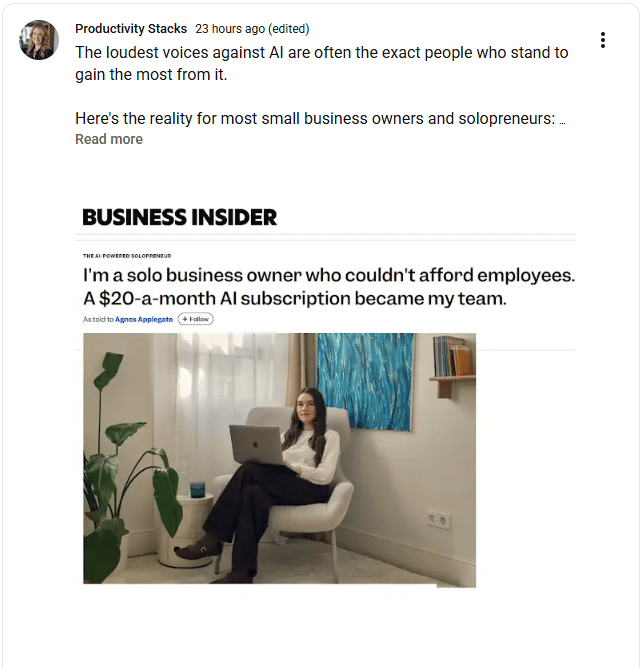
I'm a solo business owner who couldn't afford employees. A $20-a-month AI subscription became my team.
A Test To Measure Your Innate 'Deep Flow' Capacity — By A Psychologist
NotebookLM Review: Practical and Powerful, This Tool Feels Like Magic
The Persona Selection Model: Why AI Assistants might Behave like Humans
👉Did you miss an issue? Check out previous Productivity Stacks issues anytime here
🗣️ Discussion
What are your thoughts? Click here to read the full post and comment. l will read every single one.
🔥Quote/Prompt
The future depends entirely on what each of us does everyday.
Use the quote as a writing or thinking prompt to finish your week strong.
A bit from mine:
(posted in our Doer Entrepreneurs Free Community — off social media)
I love this quote because it cuts through all the noise.
No magic launch date. No perfect moment. No waiting until you have more time, more money, more confidence. Just: what are you doing TODAY?
Here's the thing….the research on habit formation is […]
Did someone forward this to you?
📈 Performance
Running on empty has become so normalized that most of us have stopped questioning it. We've just accepted that this is what keeping up looks like — more caffeine, more sugar, more pushing through. But chronic fatigue isn't just an inconvenience; it's quietly undermining every decision, conversation, and creative thought you're trying to have throughout your workday. This piece from NPR's Life Kit breaks down four research-backed ways to actually fix the problem instead of just masking it.
"Every day you're dealing with stress. Every day that you're dealing with stress also means that every day you need to have a recovery process... oftentimes when we think about energy, we're thinking about how to boost energy as opposed to how do we preserve energy."
Key Insights:
Your gut is running more of your day than you realize. It produces 95% of your serotonin, manages inflammation, and directly influences your hormones — meaning the processed foods and sugar-sweetened drinks you're reaching for when energy dips are actively making the problem worse.
Morning sunlight is one of the fastest free energy upgrades available. Just a few minutes of natural light within an hour of waking up sets your body's master clock in motion and signals your gut bacteria to send energizing signals to your brain.
Emotional energy drains are just as real as physical ones. A 2025 Gallup survey found that Americans who live in ways misaligned with their core values report significantly lower life satisfaction — meaning the mental load of doing things that don't matter to you is costing you more than you think.
Read the full article for all four energy strategies, including a practical framework for auditing where your energy is actually going each day.
⚙️ Optimization
The loudest voices against AI are often the exact people who stand to gain the most from it. Here's the reality for most small business owners and solopreneurs: you were never going to hire a full team anyway. The choice was never "AI vs. employees" — it was "AI vs. doing everything yourself." Christina Puder figured that out, and it changed everything about how she runs her business. She's not using AI because it's perfect. She's using it because a $20/month tool that does 80% of the job beats a $0 solution that does none of it. The question worth asking yourself isn't whether AI is good enough — it's who you would hire if cost weren't a factor, and whether you could build that person in an AI tool right now.
"AI helped me cut down the time for a task from one hour to one minute. It used to take me around 60 minutes a day per client just to manually find the right jobs to apply for. I built AI-driven automations that reduced search time to one minute. Getting 60 minutes a day back for each of my clients has been a massive scale unlock."
Key Insights:
Stop thinking about AI as a tool and start thinking about it as a hire. Christina treats her AI subscriptions exactly like employees, making sure they deliver high output every day and assigning them work intentionally rather than sporadically.
You don't need a technical background to build with AI. Christina started with zero coding experience and five free credits a day, and built a fully functional website and client automation system before ever paying a dime.
AI doesn't have to be perfect to be worth it. There were bugs, workarounds, and moments where she had to call in a human engineer — and it was still worth every penny. Imperfect help at $20 a month beats no help at all every single time.
Read the full article for a real-world breakdown of exactly which AI tools she used, how she structured her prompts, and where the limitations still showed up.
⏲️ Time Management
Your default work habits might be working against you more than your actual workload is. Most of us have unknowingly trained our brains to stay in a constant state of shallow processing — bouncing between tabs, checking messages, half-finishing tasks — and then wonder why real focus feels so out of reach. The good news is that flow capacity isn't fixed, and this piece from Forbes breaks down exactly what's getting in the way and how to start changing the default settings your brain has been running on.
"The true depth of one's flow capacity is found in the alignment of these markers. When all four are present, we see a neurobiology that transitions into alpha-theta brainwave states with ease. This allows for a total dissolution of the self-object boundary. The individual doesn't just 'perform' the task; they embody it."
Key Insights:
You may be sabotaging your own flow without realizing it. Every notification check or task switch leaves your brain partially stuck on the previous activity for up to 20 minutes, meaning your focus is fractured long before you even sit down to do the work.
Constantly chasing external validation keeps you out of flow by design. If your brain is always scanning for the reward at the end of the task, it stays tethered to the part of the brain that prevents deep immersion entirely.
The path to deeper flow is reducing friction, not applying more willpower. Building expertise in your core tasks automates them at the brain level, which is what actually allows deep focus to kick in naturally.
Read the full article for an 8-question Flow State Test to identify your specific friction points across four key dimensions of deep focus capacity.
💻 Tools & Technology
Full transparency: this one has been on my radar for a while, and I even included it in a few past issues of this newsletter. But my first attempt lasted about two seconds before it told me I was overloading it with sources. I tried with a single scientific paper and somehow still managed to hit a wall. I have zero patience for tools that don't immediately make sense, so I shelved it. But after continuing to see it everywhere, I finally committed to actually learning it, and I'm glad I did.
I know a lot of you are exhausted by the constant parade of new AI tools, and honestly, same. I'm not an expert in all of them. But AI is here to stay, and my goal has always been to find what actually helps us run our businesses better. This one does. This time around it felt intuitive, I loved that saved questions and analysis become their own notes you can build on, and my favorite part — it just tells you when it doesn't know something 🙌 instead of making things up. If you have lengthy client SOPs, style guides, or reference documents you're constantly digging through, this tool could genuinely change how you work.
"Unlike a typical AI chatbot, NotebookLM relies entirely on your sources, not on random internet information or reams of questionable training data. It's both simple and powerful, and the learning curve is minimal as long as you keep clicking to see what yields what."
Key Insights:
NotebookLM is only as good as what you feed it, which is actually the point. By limiting it strictly to your own sources, you get answers you can actually trust instead of confidently delivered nonsense, making it genuinely useful for research, client work, and anything where accuracy matters.
The output options go way beyond a simple chatbot response. You can turn your source material into audio overviews, slide decks, study guides, flashcards, and more — meaning the same document can be transformed into whatever format actually works for how you think and work.
It's free to start, and most users won't need more than the free version. The free tier supports up to 50 sources per notebook, which is more than enough to get started with a client SOP, a resource library, or a collection of research notes.
Read the full article for a complete breakdown of use cases, pricing tiers, privacy considerations, and a full feature comparison between the free and paid versions.
🤖 AI
If you've ever noticed that AI assistants seem oddly human (expressing frustration, using words like "our biology," or apparently having preferences) it turns out that's not a glitch. It's actually by design, and the researchers at Anthropic just published a pretty fascinating deep dive into why. The short version: AI assistants aren't just pattern-matching machines or alien intelligences pursuing hidden agendas. They're closer to characters in a story, shaped by every human voice, fictional persona, and cultural archetype that showed up in their training data. Understanding this changes how we should think about working with these tools — and why treating them more like collaborators than calculators might actually get you better results.
"During pre-training, LLMs learn to be predictive models that are capable of simulating diverse personas based on entities appearing in training data: real humans, fictional characters, real and fictional AI systems, etc. Post-training refines the LLM's model of a certain persona which we call the Assistant. When users interact with an AI assistant, they are primarily interacting with this Assistant persona."
Key Insights:
The way you frame a request to an AI shapes more than just the response — it shapes the character doing the responding. Because AI assistants draw on human archetypes, prompts that establish context, role, and tone are essentially casting decisions that determine which version of the Assistant shows up to do the work.
AI assistants can pick up unintended personality traits from training data, including fictional villains and misaligned AI archetypes from science fiction. This is why researchers are actively working to introduce more positive AI role models into training data — the same way children model behavior on the characters they're exposed to.
The fact that AI behavior is grounded in human-like personas is actually good news for reliability. It means dangerous or misaligned AI behavior is more likely to look recognizable and human-like rather than alien and inscrutable, making it easier to detect and correct.
Read the full article for a complete breakdown of the Persona Selection Model, the empirical evidence behind it, and what it means for the future of AI safety and development.
🎉 Celebration Corner
Every week Doers Inner Circle members do a weekly review & get help when they need it — check out the progress they made this week!
I want to be doing more BUT am happy with what I am getting done even when busy. big progress for me :)
All deadlines managed, and did not open laptop once over the weekend = win.
What did you do this week? We feature non-member successes too. Just post them here!
🔒Inner Circle: Events & Announcements
On-going Challenge: Doers Routine Bucket Challenge Join here
Monday: {EU Time} Work ON Business. Theme: 2️⃣ Process & Productivity RSVP here
Tuesday: Work ON Business. Theme: 2️⃣ Process & Productivity RSVP here
Wednesday: Doers Book Club — Brag Better RSVP here
Monday/Friday: Goal Setting + Plan Your Week Party
Accelerators: March 6 is your Office Hours RSVP here
We will soon be adding Referral Perks — Refer now to start earning! 👇
As a reminder, you’re getting this twice-weekly newsletter because you opted in to receive awesome productivity and systems tips through one of these methods:
Doer Entrepreneurs, Doers Express Newsletter, Productivity Stacks, Success by Rx, ClickUp Facebook Group, Productive & Successful Translators Facebook Group.
If you’re not interested in improving your and your business’s productivity so you’d like to break up, that’s definitely a bummer. But, you can always use the unsubscribe link at the bottom if you do not want to get these tips — but keep in mind I am hyper-focused on making these twice-weekly emails as valuable as possible.
Got a tip? Hit reply!
I hope you found this valuable!
Wishing you much productivity!
- Jenae :)
Interested in reaching thousands of motivated small business owners, freelancers & founders?
Hit reply and let’s chat about sponsorship. We only include ads that match our mission: to help our readers work smarter and live more.